'Ultra-red is leading a performative enquiry into Cardew’s work which mirrors the ten-hour performance of Cardew’s Schooltime Compositions that occurred at the ICA forty years ago, in 1969'.
It would seem useful to stepback from Cardew's path to Maoism and look again at the movements and dynamism of what he was up to in the period around 1967/68 especially with regard to the 40 years anniversary of presenting Schooltime Compositions at the ICA.
From The Cornelius Cardew Reader:
At the suggestion of Michael Sargent of Focus Opera Group Cornelius Cardew has been working on a small opera book called Schooltime Compositions, which will be performed at the International Students House on March 11 and 12th (one half hour session each evening) under the titles 'Dayschool' and 'Nightschool'.
Cardew wrote -
'Each of the Schooltime Compositions in the opera book is a matrix to draw out an interpreters feelings about certain topics or materials. These pieces plus their interpreters are the characters in the opera. They undergo no dramatic developments in the book; in performance they may. The pieces plus their interpreters will be the same in both Dayshcool and Nightschool. The different matrices grew around such things as words, melody, vocal sounds, triangles, pleasure, noise, working-to-rule, will and desire, keyboard. My plan is based on the translation of the word 'opera' into 'many people working'
John Tilbury writes on this time -
Throughout the period he was becoming less and less concerned with beautiful artefacts and more and more involved with people and their ability to make their own music. He began to assume a more educative role - to which he was perfectly suited through his strong democratic sentiments, his ability to teach by example, and not least his genius for improvising. Musical education is what Schooltime Compositions (1967) is about. The work is a notebook of observations, ideas, notations, hints, diagrams, concepts, scientific experiments, geometric analogies - some direct, some oblique, but mostly presented as 'facts' with no covering instructions. For Cardew each composition was a matrix to draw out the interpreters' feelings about certain topics or materials. Here the different matrices grew around such things as words, melody, vocal sounds, triangles, pleasure, noise, working to rule, will/desire, keyboard. Some of the matrices serve as a measure of virtuosity, others of courage, tenacity, alertness, and so on. They point to the heart of some real matter, mental or material. The score tells the interpreter the general area of his potential action - he may wish or have the talent to play, or sing, or construct, or illumine, or take exercise of one sort or another, and can draw out his interpretation in that direction.
Thirty years later there's still no escaping the bourgeois critics desire for proper and 'dignified' music - here an amusing review of A tribute to Cardew, Huddersfield Contemporary Music Festival 2001
But Cardew's "Schooltime Compositions", described by its composer as an "opera book", was an experiment too far. Near the beginning, pianist Sarah Walker clapped her hands as if to say, "That's enough, children." A bewildering tapestry of events slowly unfolded, in which Cardew's music took a back seat. A be-wigged woman dressed in an abbreviated latex costume pranced around, uttering desultory monosyllables before she was blindfolded and bound to a chair with masking tape. Later, a piteous figure with a sheet over his head began mournfully flogging the floor with his belt. Among the other contributors, one sang into a pillar and another, having carried around two tape recorders, lay down for a nap. Courtesy of a TV screen, the composer himself cast a wry eye on such random proceedings as a pizza delivery and the ceremonious wrapping of a cello in aluminium foil. David Ryan had the best idea, spending most of his time on stage reading a newspaper. More enervating than innovative, it was worth experiencing – once.
Howard Skempton, who quietly played his accordion throughout "Schooltime Compositions", was heard to far greater advantage later at the Cellar Theatre. His delightfully artless short pieces for solo accordion ranged in mood from wistful waltzes and quirky dances to the contemplative mindscapes of his "Axis" pieces. Skempton's dignified performance of these poignant miniatures was the perfect antidote to the previous event's pretentious pageant and made a calmly satisfying ending to an unforgettable evening.
Paul Conway
The Independent
8th December 2001
Friday, 30 October 2009

Context of the times No.1
July 1971 Angry Carnival at Notting Hill
In the run-up to the Angry Notting Hill Carnival of 1971, Frendz made ‘a call to all progressive people; black people smash the racist immigration bill; workers of Britain smash the Industrial Relations bill. All progressive people unite and smash growing fascism. Rally and march July 25, Acklam Road, Ladbroke Grove 2pm. Black Unity and Freedom Party.’ On the gatefold sleeve of Hawkwind’s 1971 album ‘X In Search of Space’, designed by Barney Bubbles, the group are pictured playing a free gig under the Westway. That summer Hawkwind appeared on several occasions at different locations under the flyover, including the Westway Theatre on the site of the Portobello Green Arcade and to the east (where Neighbourhood nightclub would later appear). These gigs were usually benefits for local causes, during which they would merge with the Pink Fairies as Pinkwind.
The underground press ad for the ‘People’s Free Carnival August 29 – September 4 1971’ proclaimed: ‘The Streets of Notting Hill belong to the people – rock’n’roll – steel bands – street theatre – many goodies – any bands, people, ideas, or help of any sort, contact Frendz or People’s Association, 90 Talbot Road W2.’ The FreeFrendz ‘Blow Up’ Angry Brigade special reported that the ‘People’s Carnival got off to a joyous start. The street fest continues all this week so do it in the road as noisily as you can.’ The Pink Fairies were pictured amongst the kids in the Powis Square gardens, ‘at a quieter moment during the Notting Hill Free Carnival, a fantastic week of music, theatre and dancing in the street. Everybody got it on and the streets really came alive.’ Pictures of Mighty Baby and Skin Alley playing on the site of Portobello Green were captioned: ‘The weekly Saturday concert under Westway in Portobello Road pounds on. Next week Graham Bond, Pink Fairies and Hawkwind.’
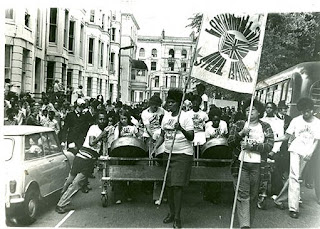
The local street hippies Skin Alley told Frendz of an anti-common market demo in Powis Square, with Julie Driscoll and some ‘very far out modern jazz trios’ who didn’t go down too well with the kids. Powis Square, during the 1971 Carnival, was also the unlikely venue of the debut with Hawkwind of the former Hendrix roadie, Ian ‘Lemmy’ Kilmister (or Kilminster), later of Motörhead. The Carnival procession consisted of a steel band led by Merle Major, an angry West Indian mother of 6, chanting “Get involved, Power to the People”; from her old house on St Ervan’s Road to Powis Square, where the People’s Association had opened a squat for her. As an effigy of her landlord was burnt, Merle Major sang the ’71 Carnival hit, ‘Fire in the Hole’, which included the line, ‘the people of the borough pay for your car.’ The Angry Carnival HQ on Talbot Road was subsequently busted by the bomb squad.

In the run-up to the Angry Notting Hill Carnival of 1971, Frendz made ‘a call to all progressive people; black people smash the racist immigration bill; workers of Britain smash the Industrial Relations bill. All progressive people unite and smash growing fascism. Rally and march July 25, Acklam Road, Ladbroke Grove 2pm. Black Unity and Freedom Party.’ On the gatefold sleeve of Hawkwind’s 1971 album ‘X In Search of Space’, designed by Barney Bubbles, the group are pictured playing a free gig under the Westway. That summer Hawkwind appeared on several occasions at different locations under the flyover, including the Westway Theatre on the site of the Portobello Green Arcade and to the east (where Neighbourhood nightclub would later appear). These gigs were usually benefits for local causes, during which they would merge with the Pink Fairies as Pinkwind.
The underground press ad for the ‘People’s Free Carnival August 29 – September 4 1971’ proclaimed: ‘The Streets of Notting Hill belong to the people – rock’n’roll – steel bands – street theatre – many goodies – any bands, people, ideas, or help of any sort, contact Frendz or People’s Association, 90 Talbot Road W2.’ The FreeFrendz ‘Blow Up’ Angry Brigade special reported that the ‘People’s Carnival got off to a joyous start. The street fest continues all this week so do it in the road as noisily as you can.’ The Pink Fairies were pictured amongst the kids in the Powis Square gardens, ‘at a quieter moment during the Notting Hill Free Carnival, a fantastic week of music, theatre and dancing in the street. Everybody got it on and the streets really came alive.’ Pictures of Mighty Baby and Skin Alley playing on the site of Portobello Green were captioned: ‘The weekly Saturday concert under Westway in Portobello Road pounds on. Next week Graham Bond, Pink Fairies and Hawkwind.’
The local street hippies Skin Alley told Frendz of an anti-common market demo in Powis Square, with Julie Driscoll and some ‘very far out modern jazz trios’ who didn’t go down too well with the kids. Powis Square, during the 1971 Carnival, was also the unlikely venue of the debut with Hawkwind of the former Hendrix roadie, Ian ‘Lemmy’ Kilmister (or Kilminster), later of Motörhead. The Carnival procession consisted of a steel band led by Merle Major, an angry West Indian mother of 6, chanting “Get involved, Power to the People”; from her old house on St Ervan’s Road to Powis Square, where the People’s Association had opened a squat for her. As an effigy of her landlord was burnt, Merle Major sang the ’71 Carnival hit, ‘Fire in the Hole’, which included the line, ‘the people of the borough pay for your car.’ The Angry Carnival HQ on Talbot Road was subsequently busted by the bomb squad.


Brecht Meets Brotzmann Uptown
Towards a dicussion of why things so weird these days and why we have to understand Cardew in the context of the times he lived and worked in.

Here is the Peter Brötzmann Quartet on Polish TV in 1974 performing the music of Hans Eisler which accompanied Bertolt Brecht's poem 'Song Of The United Front'. As you can hear it's not some straight hacked out popular communist standard but an assault on it which in no way diminishes the history of the song and thus the reason for playing it nor the belief that out there music should be conceived of as the preserve of the elite too be enjoyed only by the culturati.
http://www.youtube.com/watch?v=3Xa75w-vEXk&feature=player_embedded
SONG OF THE UNITED FRONT - Bertolt Brecht
And because a man is human
He'll want to eat, and thanks a lot
But talk can't take the place of meat
or fill an empty pot.
So left, two, three!
So left, two, three!
Comrade, there's a place for you.
Take your stand in the workers united front
For you are a worker too.
And because a man is human
he won't care for a kick in the face.
He doesn't want slaves under him
Or above him a ruling class.
So left, two, three!
So left, two, three!
Comrade, there's a place for you.
Take your stand in the workers united front
For you are a worker too.
And because a worker's a worker
No one else will bring him liberty.
It's nobody's work but the worker' own
To set the worker free.
So left, two, three!
So left, two, three!
Comrade, there's a place for you.
Take your stand in the workers united front
For you are a worker too.
I would counterpose this with this
http://www.youtube.com/watch?v=C2bGUeDnqPY
Jimi Hendrix playing / destroying 'The Star Spangled Banner' at Woodstock 1969 and playing the noises of the sound of the Vietnam war as experienced by the Vietnamese.


Here is the Peter Brötzmann Quartet on Polish TV in 1974 performing the music of Hans Eisler which accompanied Bertolt Brecht's poem 'Song Of The United Front'. As you can hear it's not some straight hacked out popular communist standard but an assault on it which in no way diminishes the history of the song and thus the reason for playing it nor the belief that out there music should be conceived of as the preserve of the elite too be enjoyed only by the culturati.
http://www.youtube.com/watch?v=3Xa75w-vEXk&feature=player_embedded
SONG OF THE UNITED FRONT - Bertolt Brecht
And because a man is human
He'll want to eat, and thanks a lot
But talk can't take the place of meat
or fill an empty pot.
So left, two, three!
So left, two, three!
Comrade, there's a place for you.
Take your stand in the workers united front
For you are a worker too.
And because a man is human
he won't care for a kick in the face.
He doesn't want slaves under him
Or above him a ruling class.
So left, two, three!
So left, two, three!
Comrade, there's a place for you.
Take your stand in the workers united front
For you are a worker too.
And because a worker's a worker
No one else will bring him liberty.
It's nobody's work but the worker' own
To set the worker free.
So left, two, three!
So left, two, three!
Comrade, there's a place for you.
Take your stand in the workers united front
For you are a worker too.
I would counterpose this with this
http://www.youtube.com/watch?v=C2bGUeDnqPY
Jimi Hendrix playing / destroying 'The Star Spangled Banner' at Woodstock 1969 and playing the noises of the sound of the Vietnam war as experienced by the Vietnamese.

Thursday, 29 October 2009
Can't dance to Cardew
History Is Made At Night:
The politics of dancing and musicking
http://history-is-made-at-night.blogspot.com/

The politics of dancing and musicking
http://history-is-made-at-night.blogspot.com/

Wednesday, 28 October 2009
Listener as Operator by Howard Slater

Compositional Improvising
An Excerpt:
Ornette Coleman was not alone in overcoming oxymorons. Whether this aim of his to play ‘improvised compositions' is a matter of an unwieldy language that doesn't quite articulate his experiential practice or an expressive practice that dismantles language by means of a ‘telling inarticulacy' could be a continuing point of debate. But, for me, this compositional improvising is representative of a defiance of the logic of language on the part of musical practitioners. How can these words fit together and make sense!? Is it, then, an indicator of ‘freedom' in music to be able to escape the confines of a language enforced logic and address affect instead? Did the use of notation in jazz represent a compromise between the two extremes of free-form and staved? Was notation a mediator that gave these internally exiled jazz musicians a sense of respectability? Did it assuage the sorrow in Eric Dolphy's voice? Or is it something much more simple. Richard Muhal Abrams, a founder member of the still-extant Chicago-based Association for the Advancement of Creative Musicians (AACM) and active proponent of this liminal zone of compositional improvising, has said ‘ ... basically musicians are performers, composers and all, at the same time. You write music when you stand up and practice your instrument.'
For Abrams, composition seems to be something that musicians are instinct with, a form-making immanence, but it is also a co-operative and collective practice, a relational proximity of singularities. Following on from this what we have, then, is a further defiance of a language that can neither fully articulate collectivities (the personal pronoun) nor the ‘all at the same time' of simultaneities (too tense restricted). That the AACM, like Sun Ra, resuscitated the ensemble sound of the big band is, with hindsight, a step forward into a remaking of the work of the past. Here, after be-bop's softening up of the song, there was room for simultaneous collectivities that were a little out of time. Abrams, in an interview with Ted Panken in 2007, cites Ellington and Fletcher Henderson as his early guiding lights in composition (a black compositional tradition that would go back to a pre-jazz New Orleans and one that is overlooked as soon as the word ‘notation' is mentioned). The jazz approach to composition is tellingly different. As Graham Lock informs us: ‘Ellington composed solos that sound not only like improvisations but like improvisations characteristic of specific players.' A kind of composed singularity effecting a non-classical form of jazz composition. So, if we take Ellington's bands we not only hear a well-oiled collective as insistent as history will be, but we also hear ensemble tones backing soloists and soloists soloing in unison. The sound of a future mode of organisation. We hear dance numbers, but also the onset of mood pieces like ‘The Mooche' (1928) that struggle free of the form of the blues into something multicoloured and drenched in whatever-polyphony.
Abrams and the AACM took their cue from this autodidact jazz route of the big bands and in the mid 60s, as free jazz took a hold, they worked on a more measured and spacious sound that allowed, in the manner of ‘The Mooche', for a tonal palette to be created by, at times, unusual instrumental combinations. As Abrams told Panken, ‘sound precedes music itself' and it is the freeing of sound from a metered tempo and the need to interpret standards that marks not just the AACM but the Arkestra too. Abram's piece ‘Levels And Degrees of Light' pits a choral singer with vibes, brushed cymbals and clarinet to make an, at times, indistinct wave-like piece reminiscent of something much more akin to an avant-garde chamber orchestra. But, in not eschewing the dirty timbres of free jazz, their's is a punk classical that establishes a tension point between the more classically derived avant-garde musics of the '60s and this organic experimentation that took its off-centre approach into the jazz clubs of Chicago's South Side. Indeed, lacking the university backing of the former, the AACM (a musician-led self-institution that sought the creative and representational control of their music as well as an alternative pedagogy) was entirely financed by its membership to the degree that Val Wilmer says, perhaps over-effusively, that the AACM ‘engendered the idea of musical socialism'.
One of the most widely appraised of the AACMs records is Roscoe Mitchell's Sound (1966). This record prompted jazz writer John Litweiler to declare ‘Music is the tension of sounds in the free space of silence'. His is an apt description of a title track that is as unexpected as it is form-forming (here we can hear an antecedent of such contemporary players as Taku Unami, Mattin and Radu Malfatti who have made pieces that are almost entirely filled with the ‘free space of silence'). On ‘Sound' the musicians play their instruments in unconventional ways, puncturing the half silence with slides and slips of merging tones that range from a historically informed articulacy to a ‘telling inarticulacy': the ghost of blues and be-bop slide up to breath flatulence, spit, keys and blats, rasping flies, hi-hat shakes, arco cackle etc. There is, then, a dramatic element that doesn't so much unfold towards crescendo as hover immanently over the piece which makes the listener expectant and highly receptive to the range of expression on offer. The vulnerability of the unconventional playing as well as the fragility of incorporating silence and ‘inarticulate' proto-expression, receives its support in the players' mutual risk taking: wines, moans, whimpers, rumblings. There are no virtuoso solos to speak of but a kind of gut bucket turn taking. This backs up George E. Lewis' statement about AACM music that ‘individual style is radically devalued in favour of a collective conception that foregrounds form, space and sonic multiplicity'. Such a multiplicity is furthered by Mitchell's introduction of ‘little instruments'(chains, whistles, bells etc.) that would otherwise be inaudible but whose use also adds a kind of humility to the piece: the little sounds get to be heard as an inclusion of the voiceless as well as being an indication that music is beginning again from an enticing degree zero. So, was ‘Sound' scored? Was it notated? Was it mapped? I don't think so, for as Mitchell's later group, The Art Ensemble of Chicago, seem to demonstrate, such compositional improvising comes about by means of ‘affinity dynamics' (Anthony Braxton). All the players were members of the AACM, each was composing themselves and the resultant collective practice overcomes the oxymorons! The rift between theory (notation) and practice (improvising) is not only overcome, but both notation and improvising are practised and heard in a light that casts doubt on either term's coherence. With music we need not be the slaves of language....
Complete article here:
http://www.metamute.org/en/content/listener_as_operator


The Great Learning
The Great Learning
The Great Learning [A Taxi Opera], Studio Voltaire,
A collaboration between artist Beatrice Gibson and musician Jamie
McCarthy, The Great Learning is a live performance piece and radio work
in seven parts based on the tradition of calling over in The Knowledge
(the infamous London cabbie navigation system and mnemonic device)
A complex and fascinating mathematics of the everyday, The Knowledge involves learning 320 routes or runs mapped within a six-mile radius of Charing Cross. On completing the knowledge a total of 26,00 miles will have been travelled and a total of 30,000 streets memorized as a networked configuration in the mind.
The Great Learning [A Taxi Opera], Studio Voltaire,
A collaboration between artist Beatrice Gibson and musician Jamie
McCarthy, The Great Learning is a live performance piece and radio work
in seven parts based on the tradition of calling over in The Knowledge
(the infamous London cabbie navigation system and mnemonic device)
A complex and fascinating mathematics of the everyday, The Knowledge involves learning 320 routes or runs mapped within a six-mile radius of Charing Cross. On completing the knowledge a total of 26,00 miles will have been travelled and a total of 30,000 streets memorized as a networked configuration in the mind.
Subscribe to:
Posts (Atom)